
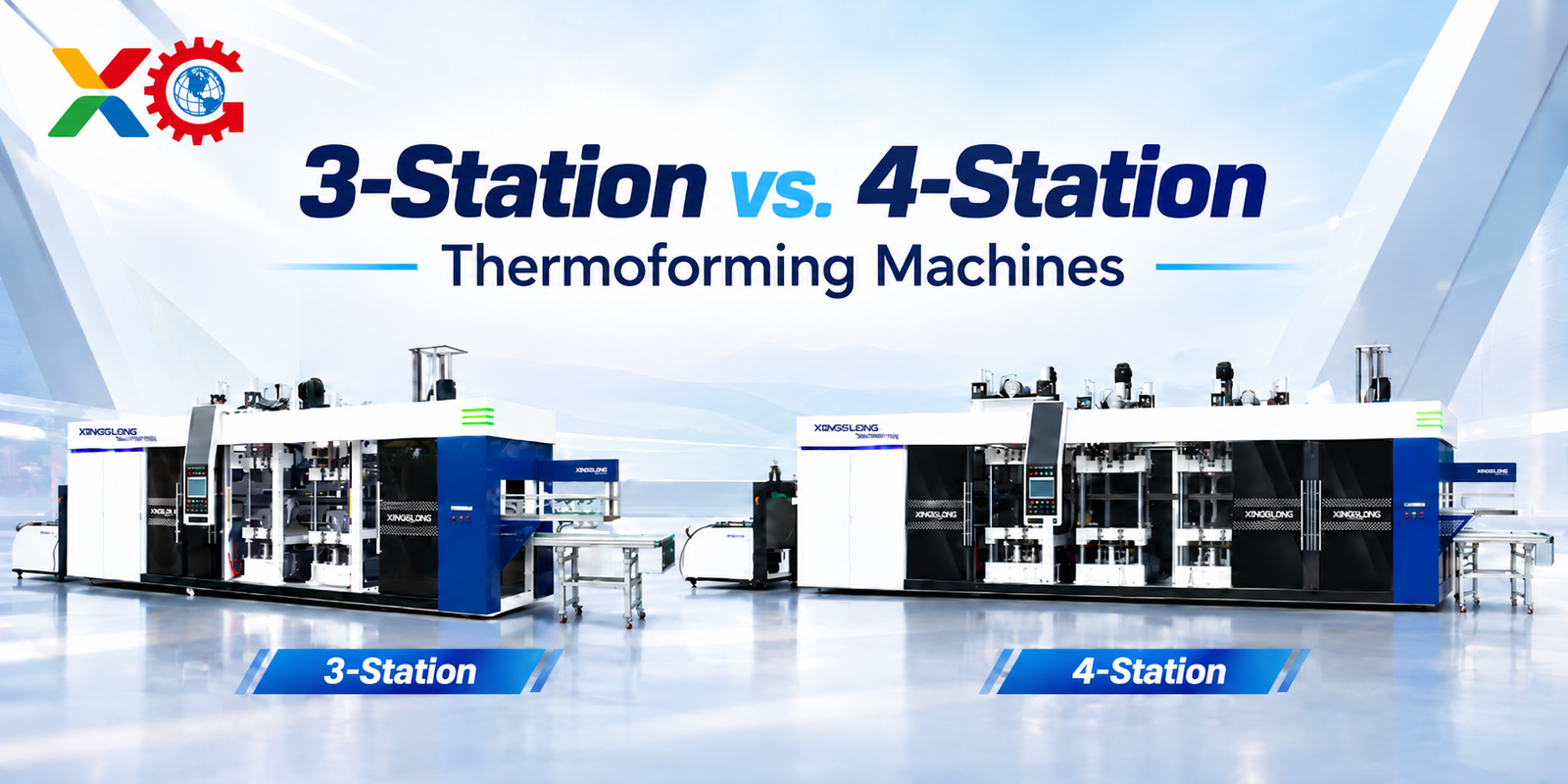
Choosing between 3-station vs. 4-station thermoforming machines is an important decision for plastic packaging manufacturers looking to improve production efficiency, maintain consistent product quality, and control manufacturing costs. Both types of machines are widely used to produce plastic food containers, trays, lids, clamshell packaging, and other thermoformed products. However, their station configurations, processing capabilities, and applications can differ significantly.
A typical 3-station thermoforming machine integrates forming, cutting, and stacking, while a 4-station machine adds an independent punching station for products requiring ventilation holes, perforations, or specialized cutouts. Understanding these differences can help manufacturers select the right equipment for their production requirements.Thermoforming is a widely used manufacturing process for producing plastic packaging and industrial products.
In this guide, XG Thermoforming, a thermoforming machinery manufacturer based in Shanghai, China, explains the key differences between 3-station and 4-station thermoforming machines, including their working principles, applications, production considerations, and investment factors to help you make an informed purchasing decision.
What Is a 3-Station Thermoforming Machine?
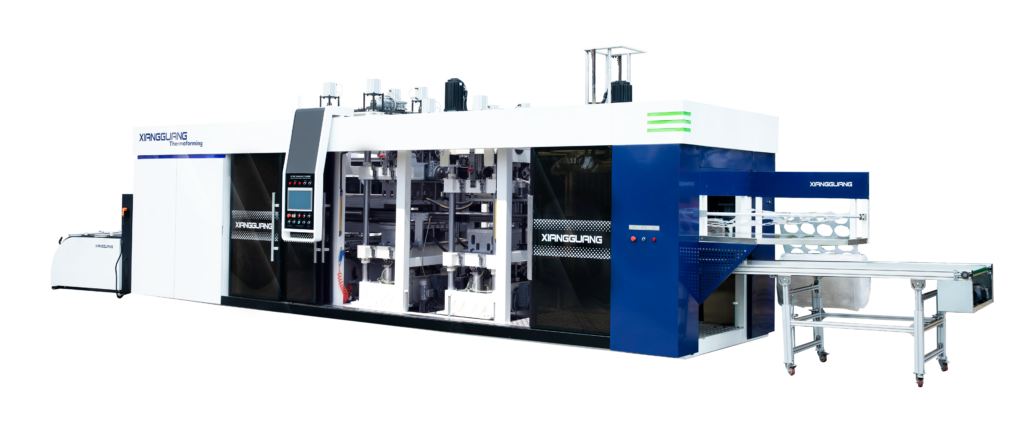
A 3-station thermoforming machine is an automated plastic packaging production system that combines three essential manufacturing processes: forming, cutting, and stacking. It is widely used by packaging manufacturers to produce plastic food containers, takeaway boxes, trays, lids, and other thermoformed packaging products.
The machine operates by heating a thermoplastic sheet until it becomes soft enough to be shaped. The heated sheet then enters the forming station, where a mold and positive or negative air pressure create the desired product shape. After cooling sufficiently, the formed products are separated from the sheet at the cutting station and automatically collected at the stacking station.
How Does a 3-Station Thermoforming Machine Work?
The production process consists of three main working stations:
Forming (Station 1): The machine heats a plastic sheet and shapes it using a mold and controlled air pressure. This process creates containers, trays, and other packaging products.
Cutting (Station 2): A cutting system separates the formed products from the surrounding plastic sheet.
Stacking (Station 3): An automatic stacking system collects and organizes finished products. This reduces manual handling and improves production efficiency.
Key Features and Applications
Modern 3-station thermoforming machines offer automated operation, PLC-based control, precise forming, and efficient production. Depending on the machine configuration, they can process materials such as PP, PET, PS, HIPS, and PLA.
At XG Thermoforming, our fully automatic 3-station machines combine positive and negative pressure forming technology with multi-stage infrared heating and automatic stacking. Selected models offer production speeds of up to 45 cycles per minute, depending on the product design, material, sheet thickness, and mold configuration.
These machines are suitable for manufacturers producing takeaway food containers, fruit and vegetable trays, bakery packaging, plastic lids, and a wide range of other packaging products.
What Is a 4-Station Thermoforming Machine?
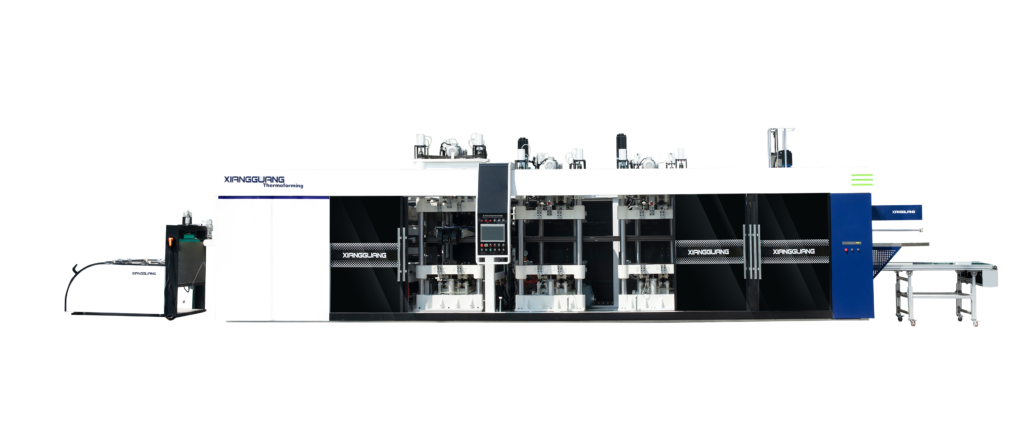
A 4-station thermoforming machine is an advanced automated plastic packaging production system that integrates four main manufacturing processes: forming, punching, cutting, and stacking. Compared with a conventional 3-station machine, it features an additional punching station, making it particularly suitable for producing packaging products that require ventilation holes, perforations, or specialized cutouts.
The machine uses positive and negative pressure forming technology to shape heated thermoplastic sheets into finished packaging products. Its integrated production process helps manufacturers maintain consistent product quality, reduce manual handling, and improve production efficiency.
At XG Thermoforming, our fully automatic 4-station machines are designed for manufacturing food containers, plastic trays, lids, clamshell packaging, and other plastic packaging products with different shapes and specifications.
How Does a 4-Station Thermoforming Machine Work?
A 4-station thermoforming machine operates through four main processing stations:
Forming (Station 1): The machine shapes a heated plastic sheet using a mold and controlled positive or negative air pressure.
Punching (Station 2): A dedicated punching system creates ventilation holes, perforations, or customized openings according to the product requirements.
Cutting (Station 3): A cutting system separates the formed products from the surrounding plastic sheet.
Stacking (Station 4): The machine automatically collects and stacks finished products for handling or packaging.
Key Features and Applications
Modern 4-station thermoforming machines combine automated processing, precise punching, efficient cutting, and automatic stacking within a continuous production line. The additional punching station provides greater flexibility for manufacturers producing packaging products that require specialized openings or ventilation features.
XG Thermoforming’s 4-station machines feature PLC-based control systems, multi-stage infrared heating, positive and negative pressure forming, and automatic product collection. Selected models can achieve forming speeds of up to 45 cycles per minute, depending on the material, mold design, product dimensions, and operating conditions.
These machines are suitable for processing thermoplastic materials such as PP, PET, PS, HIPS, PVC, and PLA, subject to the selected machine configuration and production requirements.
Common applications include disposable food containers, fruit and vegetable trays with ventilation holes, bakery packaging, takeaway boxes, plastic lids, and custom-designed industrial packaging.
Key Differences Between 3-Station and 4-Station Thermoforming Machines
When comparing 3-station vs. 4-station thermoforming machines, the most significant difference is the number of integrated processing stations and their manufacturing capabilities. While both machines are designed for automated plastic packaging production, a 4-station thermoforming machine includes an additional punching station for producing products that require ventilation holes, perforations, or specialized openings.
The following comparison highlights the main differences between these two machine configurations to help packaging manufacturers choose equipment that matches their production requirements.
| Feature | 3-Station Machine | 4-Station Machine |
| Number of stations | 3 | 4 |
| Production process | Forming, cutting, stacking | Forming, punching, cutting, stacking |
| Dedicated punching station | No | Yes |
| Typical applications | Food containers, trays, lids, takeaway boxes | Vented fruit trays, perforated lids, specialized containers |
| Punching requirements | May require additional equipment | Integrated punching operation |
| Production speed | Depends on model and product | Depends on model and product |
| Initial investment | Generally lower for comparable specifications | Generally higher due to additional equipment |
| Best suited for | Standard packaging without dedicated punching requirements | Packaging requiring integrated punching and cutting |
Both machine configurations offer advantages depending on the manufacturer’s production requirements. A 3-station thermoforming machine can be a practical and cost-effective solution for producing standard plastic food packaging, while a 4-station thermoforming machine provides additional processing flexibility through its integrated punching system.
However, more stations do not necessarily mean higher production speed. Actual output depends on factors such as machine specifications, mold cavity count, plastic material, product dimensions, sheet thickness, and production conditions. Manufacturers should evaluate their product designs and operational requirements before selecting a machine.
Applications of 3-Station and 4-Station Thermoforming Machines
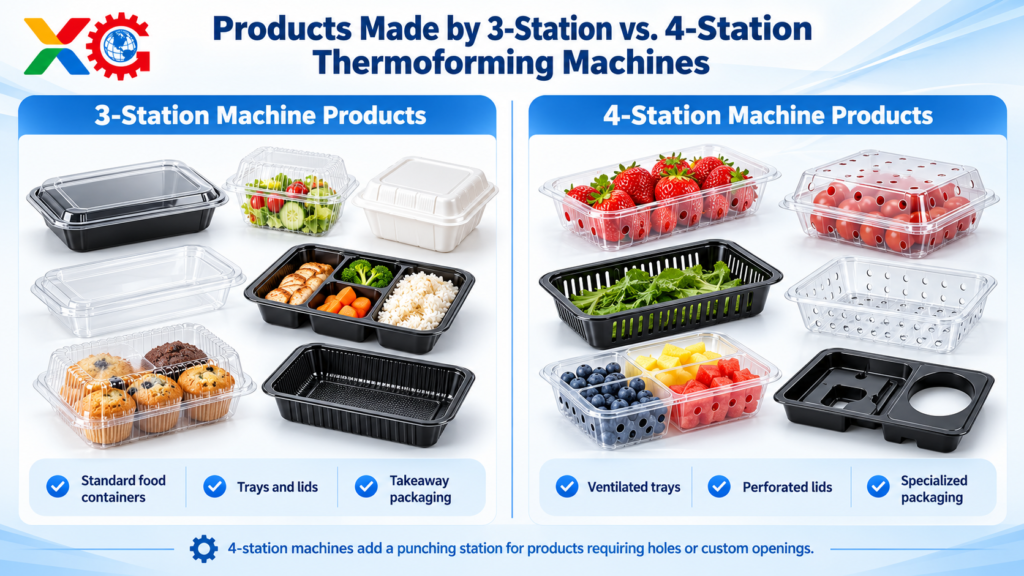
Both 3-station and 4-station thermoforming machines are widely used in the plastic packaging industry to manufacture food containers, trays, lids, and other thermoformed products. The most suitable machine configuration depends on the product design, material requirements, production capacity, and whether additional punching operations are necessary.
Understanding their typical applications can help packaging manufacturers choose the right equipment for efficient and reliable production.
Applications of 3-Station Thermoforming Machines
A 3-station thermoforming machine is particularly suitable for manufacturing standard plastic packaging products that do not require a separate punching operation. Its integrated forming, cutting, and stacking processes make it a practical solution for food packaging manufacturers seeking automated and consistent production.
Common applications include:
- Disposable food containers: Plastic containers for takeaway meals, restaurants, and food delivery services.
- Food packaging trays: Trays used for packaging meat, seafood, vegetables, fruits, and other food products.
- Plastic lids: Thermoformed lids for food containers and packaging boxes.
- Bakery packaging: Plastic trays and containers for cakes, pastries, and baked goods.
- Clamshell containers: Hinged plastic packaging commonly used for takeaway meals and fresh produce.
With appropriate molds and machine settings, manufacturers can produce packaging products in different sizes, shapes, and materials to meet market demands.
Applications of 4-Station Thermoforming Machines
A 4-station thermoforming machine is suitable for packaging manufacturers requiring additional processing flexibility. Its dedicated punching station allows the production of thermoformed products with ventilation holes, perforations, or customized openings without relying on a separate punching machine.
Typical applications include:
- Ventilated fruit and vegetable trays: Packaging with openings that support airflow around fresh produce.
- Perforated food containers: Containers designed with specific holes or openings for functional packaging requirements.
- Specialized plastic lids: Lids requiring precisely positioned holes or customized cutouts.
- Customized food packaging: Plastic containers and trays manufactured according to specific product designs.
- Industrial packaging trays: Thermoformed trays with application-specific openings or structural features.
The additional punching station can simplify the production workflow for products requiring these operations. However, actual manufacturing capabilities depend on the machine configuration, mold design, and material specifications.
For manufacturers producing both standard and specialized packaging products, selecting the appropriate thermoforming machine is essential for maintaining production efficiency and controlling operating costs.
Which Thermoforming Machine Should You Choose?

Choosing between a 3-station and 4-station thermoforming machine depends on several factors, including product design, production capacity, material requirements, available budget, and future manufacturing plans. Both machine configurations can provide efficient automated production, but selecting the right equipment is essential for achieving consistent product quality and managing long-term operating costs.
When Should You Choose a 3-Station Thermoforming Machine?
A 3-station thermoforming machine is an excellent choice for manufacturers primarily producing standard plastic food containers, trays, lids, and takeaway packaging without requiring a separate punching operation.
Consider choosing a 3-station machine if:
- Your products require forming, cutting, and stacking without additional punching.
- You manufacture standard food containers, plastic trays, or packaging lids.
- You want to reduce initial equipment investment while maintaining automated production.
- Your production requirements can be met by a conventional 3-station configuration.
For manufacturers focusing on standard food packaging applications, a 3-station machine can provide a practical balance between production efficiency, equipment investment, and operational flexibility.
When Should You Choose a 4-Station Thermoforming Machine?
A 4-station thermoforming machine is a suitable solution for manufacturers producing packaging products that require additional punching, perforation, or customized openings.
Consider choosing a 4-station machine if:
- Your products require ventilation holes, perforations, or specialized cutouts.
- You manufacture ventilated fruit trays, perforated containers, or customized packaging.
- You want to integrate punching into the automated production process.
- Your current or future product designs require a dedicated punching operation.
Although a 4-station machine may involve a higher initial investment for comparable specifications, its additional processing capability can reduce the need for separate punching equipment in suitable applications.
Important Factors to Consider Before Purchasing
Before investing in a thermoforming machine, manufacturers should evaluate their product dimensions, plastic material, sheet thickness, required production output, mold specifications, and available factory space.When comparing 3-station vs 4-station thermoforming machines, buyers should also evaluate their product drawings, mold specifications, and expected production output before making a final investment decision.
Machine selection should also account for energy consumption, maintenance requirements, operator training, and technical support. A machine with more stations is not necessarily the best option for every production line.
At XG Thermoforming, we help packaging manufacturers evaluate their product requirements and select suitable thermoforming machines and mold configurations. By considering both current production needs and future business development, manufacturers can make more informed equipment investment decisions.
Frequently Asked Questions About 3-Station and 4-Station Thermoforming Machines

What Is the Main Difference Between a 3-Station and a 4-Station Thermoforming Machine?
The main difference between a 3-station and a 4-station thermoforming machine is the number of processing stations and their functions. In the configurations discussed here, a 3-station machine performs forming, cutting, and stacking, while a 4-station machine adds a dedicated punching station. This additional station is useful for manufacturing packaging products that require ventilation holes, perforations, or customized openings.
Is a 4-Station Thermoforming Machine Faster Than a 3-Station Machine?
Not necessarily. A 4-station thermoforming machine does not automatically operate faster than a 3-station machine. Production speed depends on the machine model, mold cavity count, product dimensions, plastic material, sheet thickness, and operating conditions. The main advantage of the additional station is its integrated punching capability rather than a guaranteed increase in production speed.
What Plastic Materials Can 3-Station and 4-Station Thermoforming Machines Process?
Depending on the equipment configuration, 3-station and 4-station thermoforming machines can process thermoplastic sheets made from materials such as polypropylene (PP), polyethylene terephthalate (PET), polystyrene (PS), high-impact polystyrene (HIPS), and polylactic acid (PLA). Material compatibility depends on the machine’s heating system, forming capabilities, tooling, and processing requirements. Manufacturers should confirm material compatibility before purchasing equipment.
Which Thermoforming Machine Is Better for Food Container Manufacturing?
Both machine types can be suitable for plastic food container manufacturing. A 3-station thermoforming machine is generally a practical choice for producing standard food containers, takeaway boxes, trays, and lids. A 4-station machine is particularly useful when the packaging design requires an additional punching process. The best choice depends on the finished product design, production requirements, and investment budget.
What Information Is Required to Choose the Right Thermoforming Machine?
To select a suitable thermoforming machine, manufacturers should provide details such as the intended product type, dimensions, plastic material, sheet thickness, expected production capacity, and any special punching or cutting requirements. Product drawings or physical samples can also help determine the appropriate machine and mold configuration. XG Thermoforming can use these details to recommend equipment that matches the customer’s production needs.
Conclusion: Choosing the Right Thermoforming Machine for Your Business
Choosing between 3-station vs. 4-station thermoforming machines depends on your packaging requirements, product design, production capacity, and investment budget. Both configurations offer efficient automated solutions for manufacturing plastic food containers, trays, lids, and other packaging products.
A 3-station thermoforming machine is a practical choice for standard packaging production involving forming, cutting, and stacking. In comparison, a 4-station thermoforming machine offers an additional punching station, making it suitable for products requiring ventilation holes, perforations, or specialized openings.
Ultimately, the best thermoforming machine is not necessarily the one with more stations, but the one that meets your manufacturing requirements while delivering consistent product quality and cost-effective production.
Contact XG Thermoforming for a Customized Machine Solution
At XG Thermoforming (Shanghai Xiangguang Technology Co., Ltd.), we specialize in providing automated thermoforming machines, molds, and packaging production solutions for manufacturers worldwide.
Whether you are establishing a new plastic food packaging factory or upgrading an existing production line, our team can help you evaluate suitable 3-station and 4-station thermoforming machine configurations based on your product specifications and manufacturing goals.This comparison of 3-station vs 4-station thermoforming machines can help manufacturers choose the right equipment for their packaging production goals.
Looking for the right thermoforming machine for your business?
Contact XG Thermoforming today to discuss your production requirements and request a customized machine quotation.
Website: https://xgthermoforming.com/